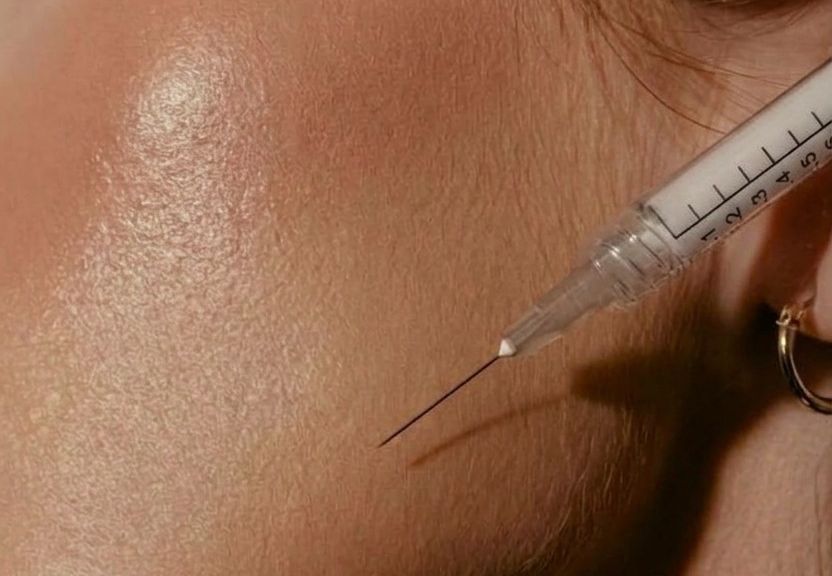
Skinboosters are micro-injections of hyaluronic acid spread across the whole surface of the skin. They are not meant to add volume: they hydrate deeply and improve elasticity, texture and radiance, for better-quality skin1,3.
Numbing cream; many products also contain a local anaesthetic
Daily routine
Small bumps at the injection points for 24 to 48 hours
Volume
Does not change facial volume or features
Reversible
Yes — being hyaluronic acid, it can be dissolved with hyaluronidase6
The times shown are averages and vary from person to person.
Skinboosters
What it treats
The product, technique and number of sessions are decided at the consultation, according to your skin quality and the area to treat.
Dehydrated, dull skin
A lack of deep hydration and radiance that creams alone cannot fix1.
Fine lines
Fine, superficial wrinkles, especially on the cheeks and around the mouth1,3.
Loss of elasticity
Skin that becomes less firm and elastic over time3.
Neck and décolletage
Areas of thin skin with lines and uneven texture.
Hands
Thinner, drier skin on the hands, with loss of quality2.
Skin preparation
Improving skin quality ahead of an event or alongside other treatments.
How it works
From first contact to follow-up.
01
Consultation and assessment
We assess your skin’s hydration, elasticity and texture, and listen to what you would like. Where appropriate, we take photographs or a 3D facial analysis.
02
Personalised plan
We choose the product and the areas to treat. The plan usually has 3 sessions, and you sign the informed consent.
03
Treatment sessions
After numbing cream, the gel is placed in very superficial micro-injections with a fine needle or cannula. Each session takes 20 to 30 minutes, 3 to 4 weeks apart.
04
Follow-up and maintenance
At the end of the plan we review the result and set up maintenance, usually 1 session every 4 to 6 months.
Skinboosters
Results and aftercare.
The skin becomes progressively more hydrated, elastic and radiant, with softer fine lines and smoother texture; the difference is clearer after the second and third sessions. As this is not a filler, your facial features and volumes stay the same. The effect lasts on average 6 to 9 months and can be prolonged with maintenance sessions1,3.
Before treatment
Tell the doctor about all your medication, including anticoagulants, and any history of cold sores.
If possible, avoid anti-inflammatories and alcohol for 24 to 48 hours beforehand.
Avoid booking a session in the days before an important event — the small bumps can last up to 48 hours.
After treatment
Small bumps at the injection points are normal and clear within 24 to 48 hours.
Avoid make-up for the first 12 hours.
Avoid strenuous exercise, saunas and intense heat for the first 24 hours.
Do not massage the treated areas unless the doctor tells you to.
Wear sunscreen every day.
Safety
Possible side effects
The most common are small bumps, redness, tenderness and bruising at the injection points, which clear within a few days. Less often, small lumps or inflammatory reactions may occur. As with any hyaluronic acid injectable, there are rare complications that need to be recognised immediately — which is why the treatment is always performed by a doctor5.
When it should not be done
Pregnancy and breastfeeding.
Active infection, inflammation or cold sores in the area to be treated.
Active autoimmune disease — assessed at the consultation.
Known allergy to hyaluronic acid or the local anaesthetic.
Taking anticoagulants — assessed case by case.
Who performs it
Performed by doctors.
All injectable treatments at FACELAB are performed by doctors trained in Aesthetic Medicine, after an assessment consultation.
What is the difference between a skinbooster and a filler?
A filler restores volume in a specific area. A skinbooster spreads small amounts of hyaluronic acid across the skin to hydrate it and improve its quality, without changing volumes or features.
How many sessions will I need?
Usually 3 sessions, 3 to 4 weeks apart, followed by maintenance sessions every 4 to 6 months.
When will I see results?
The skin looks more hydrated and radiant within the first few weeks, and the result becomes clearer after the second and third sessions.
How long does it last?
On average 6 to 9 months after the initial plan. Maintenance sessions help keep the result.
Does it hurt?
Discomfort is mild. We apply numbing cream, and many products contain a local anaesthetic.
Will it leave marks?
Small bumps at the injection points are normal and clear within 24 to 48 hours. That is why we do not recommend a session the day before an event.
Can it be combined with other treatments?
Yes. It is often combined with botulinum toxin, biostimulators or skin treatments, in a plan set by the doctor.
Can I have it if I am pregnant or breastfeeding?
No. As a precaution, skinboosters are not performed during pregnancy or breastfeeding.
Doctor accredited in Aesthetic Medicine · Portuguese Medical Association — licence no. 55532 Last reviewed: October 2026
Patient information
The procedures and treatments mentioned on this page require a prior individual medical assessment and, in some cases, a medical prescription. Indications, results and their duration vary from person to person and cannot be guaranteed. This page is for information only and does not replace a medical consultation.
FACELAB Albufeira — Rua do Estádio, Quinta da Bela Vista, Lote 2, 8200-127 Albufeira · ERS Registration Certificate: E172446 · Operating licence: 24619/2024
FACELAB Faro — Rua da PSP, n.º 22, 8000-408 Faro · ERS Registration Certificate: E180121 · Operating licence: 26536/2025
References
Kerscher M, Bayrhammer J, Reuther T. Rejuvenating influence of a stabilized hyaluronic acid-based gel of nonanimal origin on facial skin aging. Dermatol Surg. 2008;34(5):720–726.
Williams S, Tamburic S, Stensvik H, Weryho M. Changes in skin physiology and clinical appearance after microdroplet placement of hyaluronic acid in aging hands. J Cosmet Dermatol. 2009;8(3):216–225.
Reuther T, Bayrhammer J, Kerscher M. Effects of a three-session skin rejuvenation treatment using stabilized hyaluronic acid-based gel of non-animal origin on skin elasticity: a pilot study. Arch Dermatol Res. 2010;302(1):37–45.
Distante F, Pagani V, Bonfigli A. Stabilized hyaluronic acid of non-animal origin for rejuvenating the skin of the upper arm. Dermatol Surg. 2009;35(Suppl 1):389–394.
Signorini M, Liew S, Sundaram H, et al. Global Aesthetics Consensus: avoidance and management of complications from hyaluronic acid fillers — evidence- and opinion-based review and consensus recommendations. Plast Reconstr Surg. 2016;137(6):961e–971e.
King M, Convery C, Davies E. This month’s guideline: the use of hyaluronidase in aesthetic practice (v2.4). J Clin Aesthet Dermatol. 2018;11(6):E61–E68.
your beauty, our care.
Book your assessment consultation and discover a plan designed around you.